



















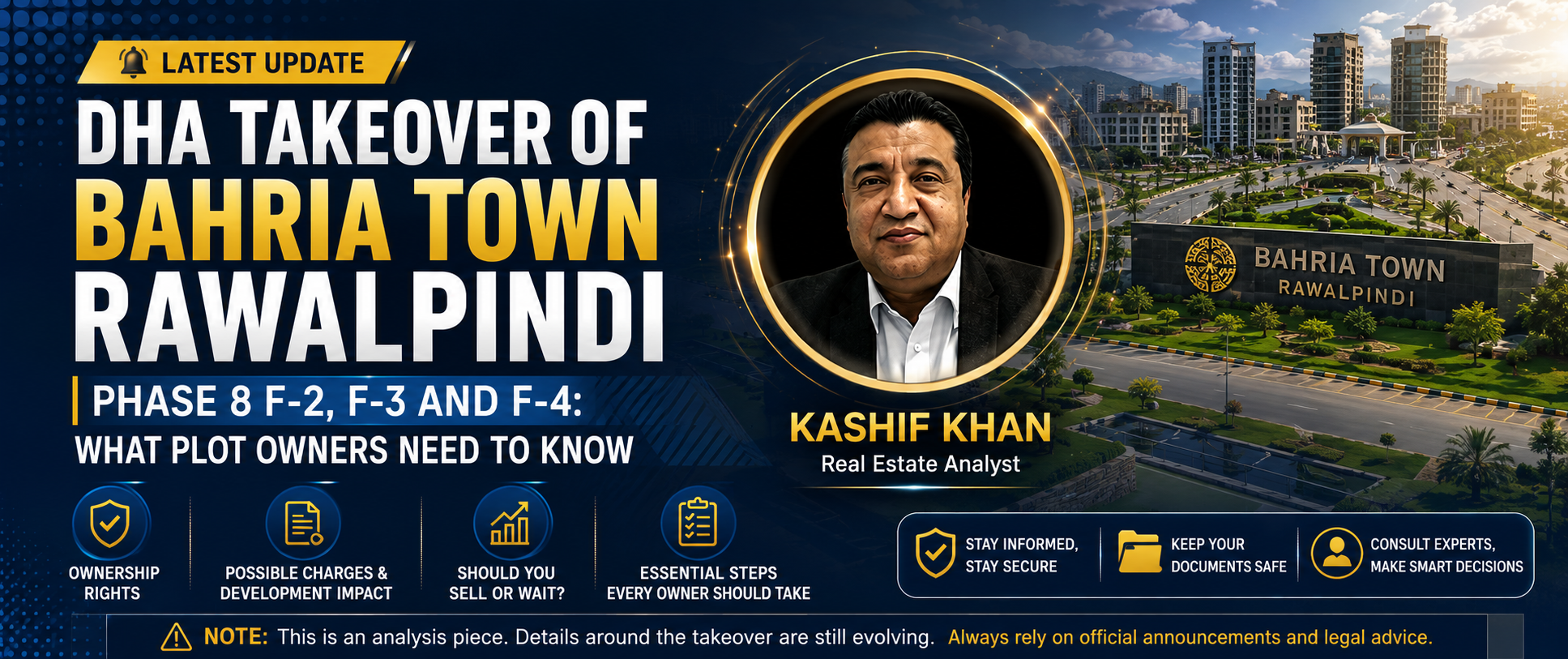
DHA Takeover of Bahria Town Rawalpindi Phase 8 F-2, F-3 and F-4: What Plot Owners Need to Know
Introduction
The recent developments regarding the reported takeover of parts of Bahria Town Rawalpindi Phase 8, particularly sectors F-2, F-3, and F-4, have created concern among plot owners, investors, and residents. News circulating through property circles, social media groups, and local discussions has led many people to question the future of their investments. Questions such as "Will my plot remain valid?", "Will ownership transfer to DHA?", and "Should I sell or wait?" are becoming increasingly common.
Property matters involving large housing societies can significantly affect thousands of families and investors. Therefore, it is important to separate facts from speculation and understand the issue from a practical perspective.
## Understanding the Situation
Reports suggest that certain sectors of Bahria Town Phase 8 may come under the administrative control of DHA. According to publicly discussed information, this move appears linked to previous financial and land-related arrangements or disputes between Bahria Town and DHA.
Many residents initially viewed this development as an immediate threat to ownership rights. However, administrative transfer and ownership cancellation are two different matters.
A change in management or development authority does not automatically mean that individual plot ownership rights disappear. People who purchased plots through legal channels and possess valid documentation generally retain their legal position unless official policies state otherwise.
However, uncertainty exists because complete details regarding transition procedures, fees, documentation requirements, and implementation timelines are still evolving.
Why Did This Situation Arise?
Several factors are believed to have contributed to the current situation:
1. Historical Land Agreements
Large housing projects often involve complex land acquisition agreements between private developers and government-related organizations. Disputes can arise regarding:
Ownership rights
Development obligations
Financial commitments
Revenue sharing arrangements
Land transfer conditions
2. Financial Settlements
Industry discussions suggest that some sectors may have been transferred as part of broader settlement arrangements between the concerned organizations.
3. Administrative Restructuring
Another possibility is restructuring of development responsibility where one authority assumes future planning and management responsibilities.
Regardless of the exact reason, the impact on property owners remains the primary concern.
Concerns of Plot Owners
Owners in F-2, F-3, and F-4 are facing several concerns:
Ownership Uncertainty
The first fear many people have is whether their plot ownership remains secure.
If an owner possesses:
Original allotment letters
Transfer letters
Receipts of payments
Possession documents
Purchase agreements
Tax or development fee records
their position is generally stronger compared to owners with incomplete records.
Additional Charges
A common concern is the possibility of new development charges or transfer fees under a new administrative structure.
Previous examples in real estate transitions sometimes involved:
Documentation conversion charges
Membership fees
Development costs
Transfer processing fees
However, official confirmation remains necessary before assuming such charges will apply.
Delay in Development
Whenever administrative disputes occur, development activities can slow down.
Possible impacts include:
Delayed possession
Delayed utilities
Road infrastructure delays
Construction restrictions
Market uncertainty
Property Value Fluctuations
Real estate markets often react emotionally to uncertainty.
During uncertain periods:
Some owners rush to sell
Investors become cautious
Prices temporarily fluctuate
Dealers may spread rumors
Such market reactions may not always reflect long-term value.
What Should Plot Owners Do?
Instead of reacting emotionally, owners should take practical steps.
Maintain Complete Documentation
Owners should organize all records carefully, including:
Purchase receipts
Allotment letters
Transfer records
Payment schedules
Possession letters
Communication records
Digital copies should also be stored safely.
Avoid Decisions Based on Rumors
Social media and property discussions often create panic.
Owners should rely on:
Official notifications
Verified announcements
Legal documents
Authentic property sources
rather than unofficial claims.
Consult Property Experts
If a plot involves significant investment, owners should seek advice from:
Property lawyers
Legal consultants
Authorized representatives
Experienced real estate professionals
Professional guidance becomes particularly important where ownership or possession status is complicated.
Assess Individual Risk
Not all owners face the same level of uncertainty.
Generally:
Lower Risk
Developed plots with possession
Constructed houses
Moderate Risk
Possession plots awaiting construction
Higher Risk
Undeveloped plots
File-based investments without possession
Should Owners Sell Their Plots?
Many investors immediately consider selling when uncertainty appears.
However, panic selling often creates financial losses.
Before selling:
Ask the following questions:
Is there official confirmation regarding future policy?
Is the market reacting to facts or rumors?
Am I selling because of fear?
Does my plot have long-term value?
Real estate frequently experiences periods of uncertainty that later stabilize.
A rushed decision can sometimes result in unnecessary losses.
The Future Outlook
If DHA formally assumes responsibility for these sectors, several outcomes are possible:
Documentation conversion processes
New development plans
Infrastructure improvements
Updated regulations
Revised management systems
Some owners may eventually view such changes positively if development standards improve.
However, until complete official details emerge, cautious optimism remains the most balanced approach.
The situation regarding Bahria Town Rawalpindi Phase 8 sectors F-2, F-3, and F-4 has understandably created concern among investors and residents. Yet uncertainty should not automatically be interpreted as loss.
Plot owners should focus on facts, maintain complete documentation, avoid panic decisions, and wait for clear official communication before taking major financial steps.
Real estate investments often experience periods of uncertainty, but informed decisions generally perform better than emotional reactions.
As more official information becomes available, property owners will be in a stronger position to determine the most suitable course of action for their investments.
One note: because details around the takeover are still evolving, present this as an analysis piece rather than a statement of settled legal fact.,